Saturday, February 18, 2012

On Camping and Climbing

Barring all apologies for being a bit slow with my blog posts, it seems this might be the frequency from here on out, not for lack of adventure or thrill, but rather because, quite honestly, I've got better things to do than waste time on my computer…although writing is justifiable, I simply get too distracted and a blog post that should take an hour to write ends up taking three, et cetera. Anyway...


It'd been a while since Ari and I have really gone anywhere or done anything exciting on our own volition, so we were overdue for an adventure, and anxious to take our new climbing gear for a spin, and the weatherman predicted bluebird weather for the weekend. Quite the ideal combination. So we packed our harnesses and rope and shoes, threw in a tent and some food and warm clothes, and set off for the Arab North. We were headed for the cliffs near Gita, a tiny Jewish settlement near Ma'alot Tarshiha. Well, Shabbat has always impeded our weekend travel plans, at least to some extent, but it really made things very difficult, as the ideal bus that would take us a half-hour walk from Gita wasn't running on Friday, meaning we had to settle for a bus requiring a two-hour walk down roads not meant for pedestrian travelers.

As an aside, I sincerely hope this blog post finds its way through the jumble of Google searches and indexes to the eyes of hopeful climbers in Israel who don't read Hebrew, as the information on this place is really very scarce on the web, and finding our way there sin car was a bit tough. This is a map of our path to the cliffs, bus route in blue, walking route in red. All in all, it took us about five or six hours of travel from Tel Aviv to get there. Rent a car, folks.

Bus in blue, walking in red
Although public transportation has, in our past, been our best friend, in this one situation, it really, really, really would have been nice to have a car. Essentially to get there, we had to take a train all the way north to Nahariya (which incidentally was incredibly relaxing), the northernmost coastal city in Israel. We had a bit of downtime there where we hung out at the beach and had some yummy falafel. From Nahariya, we took the Nateev Express local number 43 service to Ma'alot Tarshiha and beyond, to Yanuh. If you're traveling to Gita by bus, don't go on Shabbat. Go any other day of the week and take the 35 from Acre directly to Jat, it'll save you a lot of time.

Killing time on the bus
Turns out the 43 goes through Kfar Vradim, where our madrich from Jerusalem, Amir, lives (see blog post on Mount Meron). After alighting in Yanuh (we were indeed the last people on the bus), we began the two hour trek on foot. We wound our way through the Druze village of Yanuh, located on top of this beautiful ridge, with sweeping views of Nehariya, Acre, Haifa, and of course, the Mediterranean in the background. We had to straddle the side of the road down to Jat, which lacked a significant shoulder. The walk was a bit tedious, but the views were incredible. Once we got down the mountain, it was a lot easier, and we talked and walked and walked and talked, and sooner or later, we ended up at Gita (just follow the signs once you get to Jat).

Village of Yanuh with Druze flags on street lamps
Ari on left, Druze couple on right
Gita is tiny, yet beautiful. According to Wikipedia, there's only 200 people who live there. It was getting dark at this point, so we didn't linger. From Gita, we followed some directions printed off the internet. Basically, we went to the south-western corner of the settlement and followed this dirt road west, towards the sea for about ten minutes, until we found this quarry. Descending into the quarry, you'll find the path continues at the south-eastern side of the quarry, and the road starts to go down into the valley. You'll pass through a gate in the barbed wire, and then just followed the established path down the slope until you reach the cliffs on your left.

The quarry, great reference point for wayward travelers
Routes left of the boulder
And then we were here. And shit. We were in a valley called Nahal Beit HaEmek, literally stream of the house of the valley (real original). Regardless, we were incredibly isolated in the Druze north, and for a night, I felt out there, disconnected. This feeling alone justified the difficulty we faced getting here.

Moo
We set up our tent on a terrace at the base of the cliff, a place where people have clearly camped before. The night was lazy, we just explored the cliff face a bit, eyeballed the thrity-some-odd routes, ate quinoa and salad, and called it a night, exhausted from traveling. The night was a bit strange. First off, there are tons of wild dogs in the region, and occasionally, one would bark, which would cause the whole valley to erupt in a cacophony of responses. Also, it was windy…really windy. Of course, I forgot the tent stakes, so our tent was oscillating like one of those springy doorstops for the whole night. I didn't sleep well.

Ari by sunset
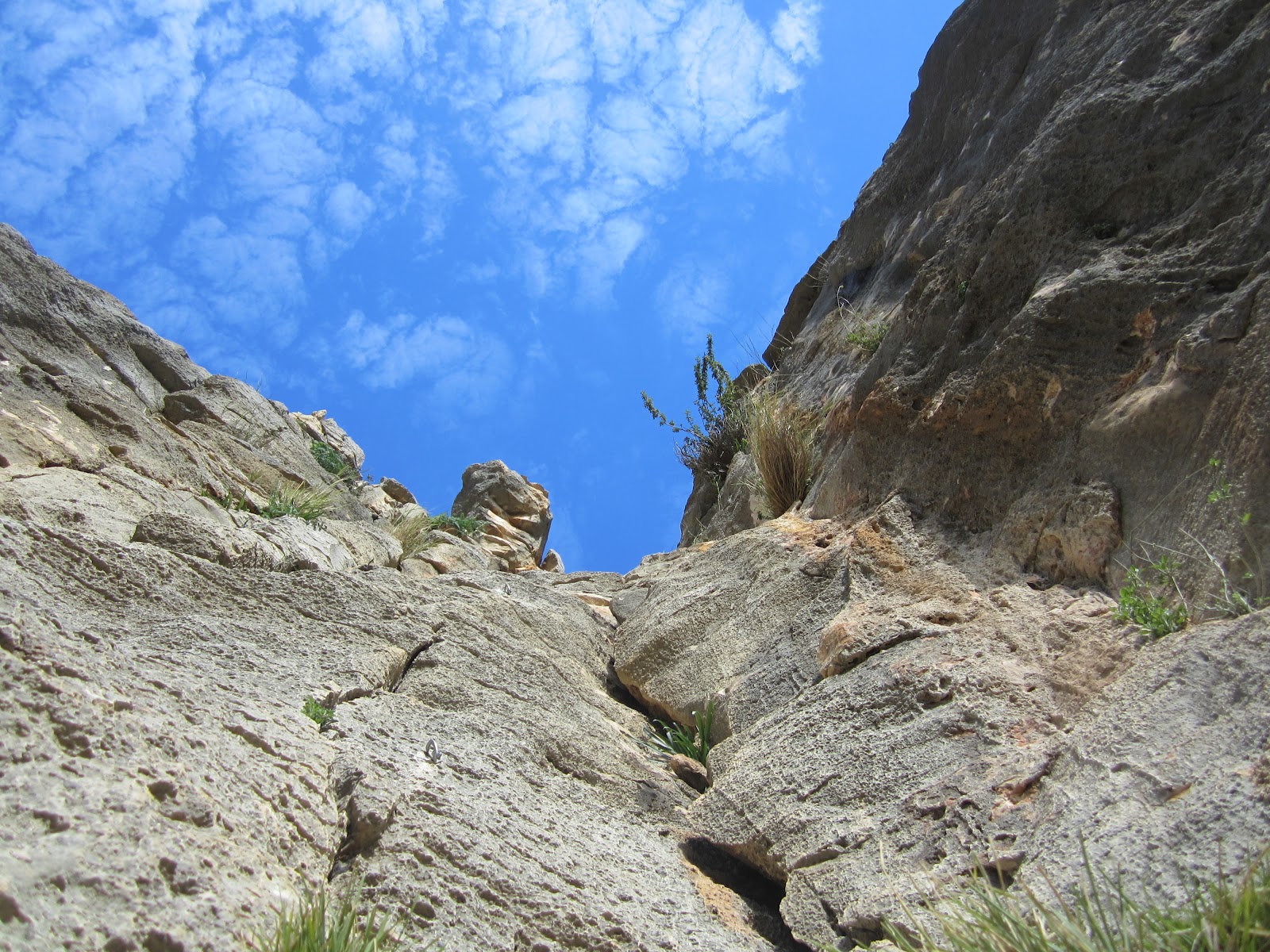
We woke up at around 8 in the morning to beautifully blue skies and feeling incredibly enthusiastic about the day to come. We ate, donned our gear, and set out to climb. This was our first time climbing actual rock, and as it turns out, it's a lot more difficult than in a gym. Where I can climb a 6b in a gym (5.10c), I came pathetically short of climbing any 5.10's at Gita (granted it had been about a month since I'd climbed before, and I slept like shit). And it's scary. Being fifty meters off the ground is much more of a mental battle than a physical one, at least at my level of climbing. But man is it a great feeling to get to the top, set up anchor, and rappel down. It's rewarding on a basic level; reward stripped down to its components, not hidden behind years of work. Despite how much I need to improve, it was great just to be at the cliff face.

Climb time

The routes at this place are incredible. They have everything here, crack climbing, strength routes, long routes, short routes. And they're so very difficult…or maybe I just suck, I'm not sure. But regardless, I need to get significantly better before I can do anything serious at Gita.

40m up, tent's a speck from up here
At around 10, other people started showing up, all climbers. So we talked and hung out. Ari and I weren't climbing all the time (we actually wore ourselves out rather quickly), and when we weren't we sat around, I napped a bit, he drew, etc. One of the parties there brought a dog, who spent a good amount of time with us. About halfway through the day, Ari cut his finger pretty badly, so that was basically that for climbing.

Good vibes

When it started to get dark, we trekked the whole route in reverse and caught the 35 when it started running to Acre.

Fooling around
So that was our fun weekend adventure.

Beethoven - Sonata No. 17 in D Minor - "The Tempest"

Monday, January 30, 2012

Tilt-shift function on my new camera
Countryside in the north

Elite Aardvark hiking crew

On Volunteering, Improved

I decided sometime last month that if I'm going to be spending a significant portion of this year volunteering, I want to be doing something valuable to both the community and to myself. Enter Ultimate Peace.

Ultimate Peace is an organization that's goal is to teach young Israelis to play ultimate, and through the spirit of the game, to promote peace. The organization has numerous "camps" set up throughout Israel, mostly in Israeli-Arab towns, but also in some Jewish towns and Palestinian towns in the West Bank. The organization is all-volunteer, with mentor-coaches going to every camp each week to host an organized practice—stretches, drills, and a scrimmage. Ultimate Peace splits the coaches into three teams consisting of two committed volunteers who go every week and a few occasional volunteers. Each team goes to multiple camps every Friday to hold practices.
Arab and Jewish kids shaking hands before the "disc-in"
 My coaching team is led by Dan, who is one of the foremost ultimate players in Israel. He coaches the Israeli National Team, runs an Ultimate league, and plays actively on the best Israeli club team. Needles to say, he's dirty. Anyway, this Friday, Dan, Abe (another committed volunteer), and I went up north to two Arab towns: Tuba-Zangaria and Daburia. We left Tel Aviv at 8 and got to Tuba at 10. The sessions take place, for the rainy season, in local gymnasiums. The kids in Tuba were great. They have pretty developed throwing skills and are learning the fundamentals of the game (which I never took the time to learn). I helped with some of the drills, feeding the kids throws and collecting discs. At the end of the practice, we scrimmaged and I was man-on-man with Dan, who ran circles around me without breaking a sweat. Fun.
Scrimmage with the kids in Tuba-Zangaria
We left Tuba at 11:30 and got to Daburia at 12:30. The kids at Daburia are a bit more advanced and energetic, so we focused on more complex concepts, like faking and forcing. After the session, we got shwarma and headed back to Tel Aviv, stopping at the beach on the way back to watch the storm-fueled waves devour the beach. And this will be every week. Yeee.
Dan showing the kids the business in Daburia
It was really incredible to work with Arab kids in such a fun environment…I'm starting to see a different side of things. And I'm going to get much better at ultimate through coaching, which is a fantastic benefit.

Ultimate Peace is one day a week for eight hours, leaving me with a good chunk of empty volunteer time. For two days a week, I'm essentially apprenticing at a woodshop where they host classes on woodworking, as well as making furniture. For the last couple days, I've been organizing wood to size and chopping them down with power tools. Isn't that great? I get to work with power tools for a volunteer job. The best part of the job is that I'm allowed to make whatever I want for myself using their wood. Today, I had the place to myself for a while, so I made a paper towel dispenser. Simple, but a great addition to our apartment. The resources at the woodshop make the art studio I did sculpture work in look pathetic. They have so many tools and so many different types of wood. I'm going to make it a point to make something small at the end of each day there…gifts for friends, things for the apartment, or whatever.
Chilling at the woodshop
So that's my volunteering schedule. I'm so thankful to be working in environments where I can actually take something out of it.

Something for Windy - Bonobo

On Tel Aviv (!)

I'm not too sure where to begin on this post. I have too much to say for one post, so this will be the first in a series of a few.

I've decided Jerusalem isn't a city. By all technical definitions, I guess it would have to be a city. A million people strong would have to make it a city. But it never really felt like a city. Sure, I whined a bit about the urban plight and sacrifices necessary to adjust to live in a place with the density of a waddle of penguins huddling for comfort (a slightly applicable analogy). Still, Jerusalem is safe. Most everyone is religiously Jewish, and Jewish values promote a very…interesting environment. Needless to say, Jerusalem is different. It's not a city in the way New York, or Boston, or Hartford, for that matter, are. It's too wealthy, too beautiful, and the culture is based so heavily on tourism that it feels like I was living in a zoo. I hated being grouped with the American tourists because I spoke English (I mean, I am an American tourist, but, like, yeah). The nightlife in Jerusalem is even weirder. It's a mix of religious Americans and asshole Israelis, granted there are some interesting people here and there. I guess I'm coming to realize this as I type this, but it was never really my scene.

Tel Aviv is a fucking city. The roads are constantly brimming with people. Urbanization is everywhere. Plots of land are perfectly rectangular, with buildings nuzzling their neighbors. The city is not a perfect grid, but most of the city follows a general north-south pattern, our neighborhood especially. And it's big. I mean, big is relative. Jake from London doesn't seem to know what I'm talking about, but compared to Jerusalem, and compared to Hartford, Tel Aviv is huge. I'll talk geography at some later post, when I've had the change to significantly explore the city.

Beach after a stormy day
We live in Florentine, a neighborhood in southern Tel Aviv, originally built to house an influx of immigrants (I think Baltics this time). It's pretty hood, as most immigrant neighborhoods are. Nowadays, there's a mix of immigrant workers and hipsters living in Florentine (I guess it's ironic to live in the ghetto). But actually, there's been a significant revival effort in the neighborhood and it's now one of the trendiest places in Tel Aviv for the younger crowd. There are some really, really cool places. Hoodna Bar has live music most nights. Chocolulu's restaurant has some of the best food I've had in Israel. Levinski Market is miniature shuk. I'm more than happy to be here. It's something so different from anything else I've experienced.
Dinner at Chocolulu's
 Most importantly, there's a wide spectrum of peoples in Tel Aviv, not just religious. Secularity…There are people who play ultimate every day; there are people who kitesurf every day; there are people who bike instead of drive a car, and people who live in tents . There are people who love life, and there are people who hate it more than anything else. Diversity here is limitless.
Graffiti everywhere...everywhere
Our apartment is pretty chilled. It's four of us: Ari, I, and two new kids—Michael Fooks and Adam Wertheimer. They come from extremely different backgrounds as us, but we get along well enough. They're clean people, which goes a long, long way. The place itself is pretty nice in it's layout. It's small, but well furnished and it has a homey feeling to it.

The social dynamic has been a bit revamped. Our section has doubled in size, and we've been integrating relatively seamlessly (from my end). Aardvark has been dealt a pretty good hand this time around. Many of the new kids are more than willing to step outside their comfort zone, willing to explore and do and see things they've never done before. Of course, there are people who aren't, but it's nice to have a larger circle of peers to socialize with. I think 44 is a good number (certainly not the first time I've seen this number). Ari and I have been cooking more than ever, and we've been having people come over mostly every night for dinner. Last night, I made goat cheese, balsamic reduction pasta, wild rice, and Ari made eggplant parmesan, to entertain a crowd of about 8. It's really great fun.
New faces!
I've been keeping to some very good habits. I've started eating mostly organic food (my breakfast this morning was muesli and chai). I've been passionate about my volunteering (see my next post). I've been writing, reading, and meditating often. I've been practicing Hebrew frequently with friends, as well as studying on my own. I've been very productive, neat, hygienic, responsible, and social. I barely have touched my computer since I moved to Tel Aviv. And I feel really, really good about myself, and I feel healthy.

We Will Commit Wolf Murder - of Montreal

Friday, January 6, 2012

Sitting yet again at Aroma in Mamilla. I should be at volunteering (sorry Paula, it's the last week), and it seems this semester has come full circle…but we know that's not true. I must say, today is an incredibly beautiful day. It's about 60 degrees, sunny, and not a cloud in the sky. This past weekend was fantastically peaceful, remarkably mind-blowing, and perhaps the greatest music festival I've ever taken part of. It was certainly the most spiritual.

The 6th Galactic Rave at the Desert Ashram, celebrating the last new year of this era. Where to start…

Ashram Bamidbar functions as an actual Ashram (see: Wikipedia) when there is no festival, with group meditation in the morning and work in the afternoon, three communal meals a day, drum circles, and instruments at night by bonfire. The grounds, as such, abound with creativity, artwork and sculptures. At the end of the Ashram is a gate to the Negev that's always open. Upon exiting, you're made aware of just how very isolated you are. It's 70 km to Mitzpe Ramon and 80 km to Eilat, the two closest cities. In between: desert, and more desert. Essentially, Shitim is one of the most isolated place in Israel.

Ashram Bamidbar
We were six people strong: Ari, Jacob, Gabz, Raquel, Zoe, and I. The crew was originally supposed to include Oscar, but complications arose and he never ended up coming. Eh. We all split a sheroot (a large taxi) from our apartment all the way down to the non-existent entity called Shitim, appearing on maps for cartographical reasons, I think. Shittim is a power grid converter and a couple large water tanks, as well as containing the spiritual mecca, Ashram Bamidbar (lit. ashram in the desert)

We all got to Ashram at about 21:00, set up camp (I brought a large, bamboo rug, and a few tapestries to decorate), and Ari and Gabz cooked a yummy couscous dinner.

Dinner by headlamp
Camp Aardvark
Thursday night was welcoming. Everyone was excited to be taking part in the festival; everyone was excited to be alive.

Festive!
There was an incredible moment of awe as I set out to explore the premises. It's a wonderful place: there's a koi pond I spent many hours sitting in front of, thinking and exchanging pleasantries. The bonfire drew people together like flies to a lantern. There were so many beautiful people, in every sense of the word. And it was a festival with really amazing music, the kind that I would listen to on my own: downtempo, electronica, and psytrance. I even gave the DJ a hug after his set.


Thursday was an early night…I crashed around 3:00, and despite the booming music, was able to sleep relatively well in my yellow tent, my mobile home. Friday morning was overcast and on the chilly side and we ate our oatmeal surrounded by grey negev (a suiting environment for eating oatmeal, I suppose). I took off after breakfast with a camera, trying to capture the atmosphere of the desert, and falling pretty far short, as to be expected. Nevertheless…

Bliss

Setting off on my own, I decided to walk into the desert and just keep walking. I saw the most perfect tree in the distance to sit underneath and meditate, so I spent about 20 minutes walking towards it, only to see someone already sitting under it. Bummer. So I settled for a mediocre tree about 5 minutes further. After I've been sitting there for about half-an-hour, I see a person approaching me.

"Noah?"
"Ari?"

Turns out Ari was off wandering the Negev at the same time, in the same place, collecting rocks, and basically doing what I was doing. What's remarkable is that we were a good 25 minutes away from the Ashram. "That's saying something." Anyways, we walked back to the festival together, reunited with the group, made burritos for lunch, aaaand cue the rain. Piss.

I'm not going to pretend like it was welcomed. The rain really sucked. That being said, it only rains in the Negev on average five days a year, so to witness such an event was pretty rare. We hibernated in my tent for a bit before checking out the stage, which was packed with people and protected from the rain by a giant tent. Seriously, the stage area was packed, it was crazy. There were live bands all day Friday, and in between were mass-meditations (See: Vimeo...seriously, check this out).


The rain gradually petered off, and by Friday night, it was done (I gave up caring about being wet much before). There was a Kabbalat Shabbat ceremony Friday night that I went to, which was essentially two hippies singing, "YKVK! YKVK! YKVK!" Pretty funny stuff.


We all went to "Tantric Meditation" that night, which was essentially a guided meditation to explore all of our emotions. They were speaking in Hebrew, originally, so I took off, decided to explore some more on my own. Ari, who stayed, said it was one of the most interesting things he's ever done. Basically, they had everyone scream at each other and hurl insults. "You don't speak Hebrew? Why don't you fucking learn the language or just go back to you country." After an emotional barrage lasting 15 minutes, they had everyone hug each other and forgive. Next, they had everyone act crazy, and, according to his word, people went batshit. And this went on with other emotions.

 Raquel and Zoe left the meditation about when I did and we all went into the Negev. It was about midnight at this point, and we were rather drunk. Way out in the boonies of the desert area was a roaring (I mean able to support 100 people) bonfire. We checked it out, and there was a man talking in English (everyone else was quiet) talking about being prepared for the ceremony…must be hydrated…leave all inhibitions behind…etc. The hell? Maybe a cult? I was pretty confused, but we hung around. Then everyone started getting undressed, down to their underwear. I had to ask someone what was going on. Turns out, they were getting ready to enter a sweatlodge adjacent to the fire. Cool. Figuring this would be a pretty interesting experience, I stripped and joined the procession into the sweatlodge.

The sweatlodge
Inside the sweatlodge, it was pitch black. The leader had us sit in three concentric circles surrounding a circle dug into the ground for the "glowing rocks" to be placed. It was a bit too crowded, and I wasn't quite able to sit cross-legged. So I was a bit uncomfortable, but boo-fucking-hoo, whatever. He began by explaining the tradition of the "red people" and how the sweatlodge was their method for prayer. By sweating out the demons, we are able to bring ourselves closer to whatever spiritual deities we believe in. He reiterated that this will be uncomfortable, and your initial impulse will be to leave, but no matter what, to stay. Fight the heat. Okaaay. He also explained that there would be four rounds, each about half-an-hour, of hot rocks. The first round would be a bit longer, about forty-five minutes. Cue the rocks…cue the heat. The gimp (politically correct: lackey) outside brought in eight massive, glowing hot rocks. After each rock was brought in, we greeted it, "hello", "baruch haba", "welcome". After all the rocks were in, our guide had us hold hands with our neighbor and guided us through the first meditation.

Guide: All the two legged creatures, all the red people, the white people, the brown people, the yellow people, we are all one.
Chorus: We are all one.
Guide: All the four legged creatures, those that crawl beneath our feet, those that live amongst us, and those that soar above our heads, we are all one.
Chorus: We are all one.
Guide: All the plants on this planet, all the grass we tread upon, all the trees we seek sanctuary in, all the vegetables and fruit we sustain ourselves with, we are all one.
Chorus: We are all one.
Guide: And all the rocks on the planet, all the minerals, and of course, the Earth itself, we are all one.
Chorus: We are all one.

And then we chanted some Native American spiritual hymns, as well as a few Hebrew songs, which I actually knew (Hinay Matov U'ma Nayim…), all the while, sweating my balls off. Literally, I was dripping sweat, and not only was I dripping sweat, but evaporated sweat was condensing on the ceiling and dripping on my leg. Mmm. So as soon as the gate was open, round one was over, as beautiful as an experience that was, I took off, half naked, through the desert, back to the campsite.

The rest of the night I spent talking to people and taking turns between dancing my ass off and hanging out by the fire. I stayed up until sunrise, which was about 6:00, wherein we all went out to the Negev (maybe about 400 people), and all held each other as the sun rose. And then I went to bed for about…four hours? Yeah.


Saturday morning was beautiful, blue skies with a few clouds here and there adding definition to the sky. So apparently the festival ended Saturday afternoon. I originally planned to spend three nights at Ashram…bummer. We called our roommate, who had computer access, and had him look up the bus schedule, who confirmed that there was, indeed, a bus coming Saturday afternoon at 5:00.


I spent the morning in the Negev playing frisbee with some remarkably talented players (it's incredible to be able to throw with people of the same level I am). I threw for about two hours with maybe ten different people over that time, and took a few people's information down…I'm going to join an ultimate league in Tel Aviv, as well as volunteering at an organization called Ultimate Peace. Anyways, during the frisbee tosses, three planes flew by so, so, so low to the ground. Maybe 20 feet, if not lower. They were just dancing around the sky, it was strange, but awesome.

We packed our belongings in the afternoon, and all attended the closing ceremony. Hallelujah, by Leonard Cohen (although I think it was the Jeff Buckley version they played) came on, and everyone formed a giant "love circle" and held each other and sang along. The whole experience was really quite moving, and I felt so at peace with everything.

As we're getting ready to leave, I had a revelation. Why…do I have to go home? So I decided to stay another night at Ashram by myself, and I set up camp in the Negev beyond Ashram, the rational being that it's not like they could really tell me I couldn't if I wasn't on the Ashram itself. And I did. There were actually a significant amount of people that stayed Saturday night, and we all hung out by the campfire. At one point, there were two hangdrums (see: Youtube) being played along with a violin—one of the most beautiful harmonies I've ever heard. I went to bed at around 8:00, and ended up waking up at 10:30, decided to go back to Ashram, and joined people in singing songs around the campfire. At around midnight, music started back up, and people flooded the dance floor, bringing the party back to life.

My camp that night was something else. I was alone. Very alone. I think I was the only person camping beyond the Ashram that night, and I was a good ten minute walk from the gate. I slept without a fly on the tent that night, fighting the chilly breeze that brought the temperature into the 30s for a remarkable view of the night sky. Definitely worth the fight...people could write poems about how beautiful the stars were.

My tent and I and the morning sun
All around, this was one of the coolest places I've ever been. I'll definitely be back. I've come to realize how much more there is to life than the conventional life. It seemed like everyone there floated a few inches above the ground, and their words carried a weight that escapes description. There was so much love.

A Nervous Tic Motion of the Head to the Left (Fingerlings 3) - Andrew Bird
Dawn Chorus - Boards of Canada

Thursday, December 29, 2011

On Human Condition, The

I've been neglecting you something terrible, turquoisehexagonalsun. I apologize. As part of my Tel Aviv resolution, I'll make sure to put you near the top of the list. For some updates: December has been a rather interesting month. I haven't done too much outside of Jerusalem. I haven't actually done too much in general besides hanging out with my friends and Sarah. But I've been having a great time. Tuesday night, we went over to our teacher Mo's house for a MexiHannukah Party. We brought tequila. Ayy. Last night, we went out for Chris and Jeremy's last night in Jerusalem (I'll miss them, really). And tonight, I'm leaving for Mitzpe Ramon as our pit stop on our trek to Desert Ashram for a three day galactic rave for New Year's (Sylvester as it's called in Israel).

Anyway, I spent much of December (something akin to 15 or 20 hours) researching and writing a very, very open ended topic for our Genesis Parables class—the one with the crazy teacher. Essentially we were to pick four articles from a collection he gave us, and provide a commentary, along with insight, and how they relate back to our class. Of my final product, he said it was graduate level work, so I figured I'd share it as filler. It's 3000 words, so good luck:


My teacher, Steve, and I, at his house
Four Essays
Noah Zemel
12/25/11

I am here today to present you an argument based on not reason but of a more esoteric nature, one that flourishes within the bounds of the speculative, shying away from the logical. I ask you to leave your intellectual pursuits at the door for a more spiritual one, as I use Frankfort and Co’s The Intellectual Adventure of Ancient Man to, once more give value to speculative thought.

Let’s begin by discussing the matter at hand: what is speculative thought? The article posits that “speculation—as the etymology of the word shows—is an intuitive, an almost visionary, mode of apprehension” (3). Speculative thought draws it’s origins out of necessity, that in primitive times, speculation was the only answer to natural phenomena, the only way to explain the world and it’s complex processes. “It attempts to unify” (3). Science, today, has taken over this role. This dichotomy has created two types of thought in regards to the external world: one living in conjunction with nature and one distinctly removed from nature. Speculation is to live in tandem with nature, seeing it as not quite an entity, but much more than how it exists today: concrete, understood, an intellectual pursuit. The article explains this by means of assigning the world two pronouns: “it” and “thou.” It—the scientific “it”—is how we view the world today, standing in direct opposition to “us.” Thou—the revered “thou”—describes ancient man’s relationship to the world. While “it” is general, “thou” is unique and carries weight; “thou” deserves respect. Finally, while “it” is an intellectual experience, if that (the article uses the term “intellectual detachment” (6)), “thou” is an emotional one, understood on a much deeper basis than science could possibly present.

Clearly, speculation laid the basic groundwork for religion to be established, originating in the form of myth. Myth, to ancient man, was a truth not scientifically, but through the stories it told. To them, they understood parable better than we could possibly know, for science is rooted deep in our minds as speculation was rooted in theirs. As a speculation of my own, if ancient man were exposed to the kind of rational, ordered thought that exists today, they would be as confused as those trying to comprehend ancient parable. Myth replaced science. The article makes note not to confuse myth with fantasy. “True myth presents its images and its imaginary actors, not with the playfulness of fantasy, but with a compelling authority” (7). At its very heart, myths embody all the collective experiences of the community in a completely individualized manner: everyone had their own personal relationship with the “myth.”

The myth of creation was the ultimate means to explain the world around us. It was the super-theory that answered the most existential question in history: why? And thus religion was born, not out of fable, fantasy, and fiction, but as a parabolic truth. As rationalism overtook speculation as the common way of thought, religion lost much of its true value. Through learning parable, we can come to appreciate the stories as much more than pure fable.

But what does it truly mean to speculate? I’m not sure we’ll ever know. Indeed, it’s a dying art. It’s a romantic pursuit: the freeing of one’s mind of convention notions of thought. Speculation is “knowing without knowing.” Ancient man never paid heed to whether the stories they heard were true or not, they accepted them as the truths that speculation brings. The modern man thinks quite differently, digging, unearthing, and trying to find a historical backbone to make sense of a collection of myths. Speculation, as a tool, can help us find truths in these stories that otherwise seem nonsensical. And through speculation, parable is born.

• • •

Avivah Zornberg provides some interesting ideas on the story of creation in her essay, Reflections on Genesis. Through her text, I’ll try to establish the beauty in unity, and plunge into the root of the human condition.

She begins her musings on Genesis focusing on Rashi’s interpretation of the first verse of the story. “What Rashi claims, in effect, is that the opening sentence tells us nothing about the beginnings” (3). He says that, for thousands of years, Judaism has turned to this verse for the answer to the most basic existential question, only to be presented a rather simple phrase: “in the beginning, God created the heaven and the earth” (Genesis 1:1). Rashi’s claim lies on the basis of the syntax of the verse, that the verse is translated as “in the beginning of God’s creation”, not “in the beginning, God created.” This minute difference makes no mention of how, in effect, God created, but rather that he was already in the process of creating, thus missing the actual act and beginning in media res. Rashi further states that Heaven and Earth were not created first per the syntax, but rather had already existed. So what existed in the primordial state before God created anything? Rashi answers “water, [as it] appears in the second verse with no account of its creation” (4).

The anachronism presented in the first verse of Genesis leads us to evaluate the text with a parabolic eye. If the beginning of the text is out of order, so too much be much of the other material.

Zornberg’s text continues to discuss the events that happened on the second day, or rather, the day after “day one” (which cannot be construed as the first day as the text says ehad, not rishon). Day one represents a moment of “primordial unity” (4), one that the waters of chaos were not discerned from one another and God existed “alone in His world” (5). If day one was unity, the other six were days of separation, havdallah. Everything God then created could be seen a separation from that which already existed rather than an act of materialization. Good was separated from bad, heaven from earth, and water from land. And eventually man was separated from animals, bringing light to the main issue at hand, that man was never created, just distinguished, and his future role in the world is to further and further distinguish himself so as to conquer the world around him, nature, a phrase I will delve into in my next essay. “What man is blessed-commanded to do is not simply to propagate: the process is one […] of transformation” (9). Through transformation, we are presented a challenge. We can grow to conquer, or we can strive towards unity, as is a main concept of Judaism.

In the act of separating, God brought forth a unique paradox, “compromising His Oneness and His Greatness” (5). When He said, “let us make man” (Genesis 1:26), he was asking permission, and with no other beings in existence, he must have been asking that of himself, thus putting him in a position of both supreme ruler and subordinate. Through this idea, we can see that the very root separation, the first binary division, was a division of God within himself. As such, God must be imbued into everything around, as all other separations are a constituent of that original separation.

The text moves on to discuss the nature of the phrase “to be.” It is represented as a “sort of jelling process” (6). In a literal sense, it’s the process of finding shape, of finding form. On a deeper level, when God declares, “let there be a separation” (1:6), he is providing form for two entities that previously existed in unity. Ironically enough, the being of divine unity himself is capable of destroying that unity by creating two units, given relativistic values that define them beyond the point where they could be recognized as a descendant from said unity. Good is given a value because it is, quite simply, “not evil”, and the same value holds true for evil. In a world of pure unity, there is no good, no evil, because there are no distinctions. We, as humans, cannot possibly comprehend pure unity because we live in a world so distant from the idea of it. Everything in our lives revolves around values held relativistic to one another. In other words, we know no constants that exist in a pure form without a counterpart.

And that is the current status of the human condition. We are doomed to live a world where separation plays a pivotal role in our daily lives—it is ingrained in our ethics, our morals, and our egos. While it’s not possible for us to achieve unity (some religious views may say otherwise), it’s important for us not too get too swept up in the idea of giving value by means of comparison, for it will only promote a culture obsessed with having the best, the greatest. Through actively transforming into a better people, willing to embrace that which is separate, can we move if only the slightest bit closer to unity.

• • •

As part of Sigmund Freud’s study on psychoanalysis, he tried to categorize the elusive realm of dreams. He separated the content of dreams into two: manifest-content and latent-content. The manifest is a disguise. Quite simply, it is a cover drawn over our eyes while we rest to entertain our subconscious. Dreams of this level are a manifestation of wish fulfillment and of satiating whatever desires we dwelt on that day, or days before. Latent-content is the symbolism behind the dream. Latency is parabolic, by nature, and deeply confusing. According to Freud, the wish-fulfillment process of dreams cannot be as straightforward as giving us what we desire; there must be a filter—what Freud refers to as a censor. This censor muddies what could otherwise be instant gratification into a vision that must be read as closely as the most allegorical texts—latency.

You entirely disregard the apparent connections between the elements in the manifest dream and collect the ideas that occur to you in connection with each separate element of the dream by free association according to the psychoanalytic rule of procedure. From this material you arrive at the latent dream-thoughts, just as you arrived at the patient's hidden complexes from his associations to his symptoms and memories. (Freud, Five Lectures on Psycho-Analysis)

David Mamet begins his analysis of the Noach story by referring to Freud’s philosophy of dreams, referencing both the manifest and the latent dream. In describing the latent dream, he says, “the latent dream […] is the dream we would rather forget, which is too powerful, too upsetting, too unsettling” (59).

The story of Noach is simple enough: God gives humans the command to spread forth and multiply, and as I previously established in the previous essay, to transform and grow. Somewhere along the way, God decided that it would not be in human’s best interest to function as a whole (a logical directive, as it would violate the individuality God created for each human). “Do not band together into large groups, you will do Evil” (60). Humans, being the remarkable listeners we are, did not heed his advice, and banded together to create a monument to our greatness: the Tower of Babel. God, enraged, sent a flood to destroy all humans and bury the Earth beneath the deluge, save for Noach and his venerable ark.

The Story of Noach as a dream might seem to be a bit farfetched, but to ancient man, furnished with a different mode of thought (speculation), dreams had a vastly different meaning. To them, dreams held the same reverence as a creed, and the two were deeply intertwined. Thus, we can examine some of the texts the same way we might go about examining dreams, starting by applying Freudian psychology to the stories.

The manifest content of this dream/story is, as Mamet states, the initial act of banding together, and building structures to rival God. This is the wish-fulfillment aspect. The latent content, the deeper dream, the one we would rather forget, would clearly be the great deluge—the flood. As Freud puts it, often the latent content of dreams “conceals a primal, infantile trauma” (61). Playing the psychoanalyst for God’s dreams is treading on dangerous waters, but, I would have to agree with Mamet in that God’s suppressed desire to kill, provoked by jealously enrooted through idolatry, is manifest through this dream.

Now it would be wrong of us to stop at Freud, one of the most controversial psychologists of the modern era. Let’s look at Carl Jung’s (another esteemed psychoanalyst) approach, one more focused on the deeper meaning of the dream, rather than the suppressed desires that conduct it. Jung, like Freud, divided dream content into two categories: objective and subjective. The objective is the literal, on a basic level, the manifest. An objective dream is straightforward in the sense that it does not really require interpretation. God’s dreams/stories belong to the latter group: the subjective. The subjective is open to interpretation and deeply allegorical. Through the subjective approach, a dream was to be seen as symbolic and analyzed as such.

Symbolism such as the rising waters that buried the tops of the mountains can be seen as an entropic regression wherein separations made in the days of creation are blurred and become one again. Through an act of chaos, unity, at least for the sake of cleansing, can be achieved. Again, a paradox is presented that water, a symbol of purity, can be the end of the world that was. Maybe not what Carl Jung would have reasoned (as he was keen to provide answers, not raise more questions), but following parabolic thought, paradoxes seem such a recurrence throughout Genesis that it would be foolish of us not to acknowledge whatever value they hold.

Ultimately, Mamet ties the story together through his interpretation of the dream not merely as the manifest, the objective, but as a device that we can grow through. “One cannot have what one wants […] is the message of Noach” (62). At the end of his brief analysis, he asserts his take on the human condition, which I focused heavily on in my previous essay. To be human is “to conquer our lower nature”(62). The addition of the words “our lower” provides a drastically different image of our purpose than the previous “to conquer nature.” It stresses, first, that nature is not necessarily a single idea, but rather exists as the summation of natures differently suited to each being of God’s creation. The previous “conquer nature” seems very confrontational in a way that could be unethical. By owning “our” nature, we are not conquering anything, per se, rather finding a balance, creating our own personal unity. And the word “lower” distinguishes between natures. The nature of natures, the higher nature, is one beyond us, one of a different binary division. It is the all-encompassing nature, and to conquer that idealism would be to manipulate and position us in a way so as to rival God, and as the story of Noach shows, that does not bode well with the Divine.

• • •

To conclude my series on parabolic thought, I will use Thomas Caramagno’s review of Virginia Woolf’s To The Lighthouse to play off common themes throughout the previous essay, to shed some final light on the nature of emotion and the human condition. Let it first be stated that I personally have never read To The Lighthouse, so in referencing the text, I am referring to Caramango’s review, not the actual book.

The first paragraph yields an interesting idea to jump off of: that of expression. Through writing her book, Woolf “‘expressed some very long felt and deeply felt emotion’ which writing finally laid to rest” (244). Emotion lies at the root of all human condition; it seeps into our dreams manifest as wish-fulfillment, it influences our intuitive senses, finding its way deep, deep into the inner processes of our psyche. It is what we know best (and also the least), for emotion escapes conventional description. The disconnect between words (symbols) and feelings is seen everywhere in life, from petty arguments to advertisements toting a ring to win “her heart.” We live emotion, but to express emotion is something entirely different. It is to have an awareness of “feelings.” Through expression, we can start to mend the disconnection between the verbal and the emotional.

Virginia Woolf’s obsession with her parents subsided after she wrote To the Lighthouse, as if through expressing herself non-verbally, she was able to comprehend a little better the forces at work in her mind. Her story was threaded with metaphor, in both the figurative (the lighthouse representing a beacon), and the narrative (her bipolar shifts translated into “seventeen subjective points of view” (244)).

The issue of dreams resurfaces (I can’t seem to escape it) in Caramango’s essay, in saying, of Mrs. Ramsay as the perfect maternal figure, “[the] idyllic dream cannot be fulfilled” (248). Dreams are the ultimate vessel of expression, for we have no active control over them. Instead, they feed off our emotions, our subconscious. To capture a dream, in all its depth, would be to capture emotion. And emotion, feeling, is the root of the human condition.

• • •

These essays may seem a bit scatterbrained, for they most certainly are. They are not so random, however, to lack any central threads. My purpose in writing these essays has not been to reveal a secret unbeknownst to the world about the human condition; I would not be the right person to do that. To better understand human condition, we must better understand ourselves. I set about to inspire a different kind of thought, one enrooted in the speculative and the parabolic, that might help uncover not necessarily what it means to be human, but what it means to be. I’ll conclude with a quote from Virginia Woolf, “We are sealed vessels afloat upon what it is convenient to call reality; at some moments, the sealing matter cracks; in floods reality.”

Winter '05 - Ra Ra Riot

Tuesday, December 6, 2011

On Shabbat, Bliss

Once a month, Aardvark sponsors a Shabbaton, basically a homestead with a religious family over Shabbat. Thing like this aren't usually my cup of tea, but I was low on cash (after Shpongle) and it seemed like it would do me some good to experience a true Shabbat. Anyways, the place was Moshav Modi'in (Mevo Modi'in), located about 4km north-west of Modi'in, which in turn is directly in between Jerusalem and Tel Aviv, strafing the Green Line.

The Moshav was incredibly beautiful and had character other Moshavs lack. There was community art all over walls of houses, gardens full of fruit-bearing trees, and backyards with hammocks. The proper adjective to describe the residents would be, as Wikipedia says, eclectic.

I'll start by describing Shabbat, for the goyim audience. Shabbat is the seventh day of the week; it is the day of rest. Judaism views Shabbat in a completely different dynamic from the rest of the week, and of all Jewish tradition to keep holy, Shabbat is arguably the most important aspect of our faith (arguably does not mean I wish to argue this…I'd get sauced). Kabbalah defines Shabbat as the period of the week where the Shehinah is elevated and rises, with the help of our Mitzvot, to meet the Ohr Ein Soph in a moment of divine unity. The hell…yeah, okay. I'm not about to explain Kabbalah, but in Jewish Mysticism, God / The Divine / The Spirit-wind-of-Elohim has two components, a male, infinite being, called the Ohr Ein Soph (translated: the infinite light) that exists outside of the realm of anything finite. We do not have any direct interaction with the Ohr Ein Soph, and the only way there is any interaction between our realm and his is through a series of "lenses" known as Sephirot, basically the exact same thing as Chakras. Following? The Shehinah is the female counterpart of God and she exists in the finite realm. Judaism is all about unity, and it's our goal to unify the Shehinah with the Ohr Ein Soph by repairing the broken vessels (Klippa) and some other shit. In other words, by doing good deeds, we create an act of divine unity between the female and the male. In other words, cosmic sex. If you managed to follow that, my hat is off to you. So that's Kabbalah's take on Shabbat, it's a day of pure unity.

Aaaaaas such, you are not allowed to do a few things on Shabbat. No carrying, no burning, no extinguishing, no finishing, no writing, no erasing, no cooking, no washing, no sewing, no tearing, no knotting, no untying, no shaping, no plowing, no planting, no reaping, no harvesting, no threshing, no winnowing, no selecting, no sifting, no grinding, no kneading, no combing, no spinning, no dyeing, no chain-stitching, no warping, no weaving, no unraveling, no building, no demolishing, no trapping, no shearing, no slaughtering, no skinning, no tanning, no smoothing, and no marking. No problem.

That in mind, we got to Rabbi Avraham Arieh Trugman's and, like, damn. His place is sweet. He has an awesome yard with a fountain in it, a cave below the yard, and ancient ruins on the hill next to his house. The house itself is beautifully designed, with tons of really trippy Cabalistic paintings basically depicting some of the stuff I described earlier (God having sex with him/her self).

There were eleven of us, if I'm not mistaken. We went to shul Friday night. It was pretty weird. It seemed like half the congregation was tripping face. Dinner was served when we got back. Of course, the food was delicious and endless (definitely NOT why I decided to come…). So we ate, then we slept.

Somewhere in the back of my mind (near where I have my good judgement caged up), I decided to wake up early. Sin alarm clock, I woke up at around 6:30, got up, walked around the Moshav, stopped by the shul, meditated a bit, and read a lot. It was a gorgeous day, not a cloud in the sky and probably 60˚. We had second meal together and then we decided to check out the Ben Shemen Forest (the largest contiguous body of woods in Israel) which just so happens to surround the Moshav. The crew was Ari, Oscar, Hannah, Natalie, Adin, and Ryah. And the forest was pretty cool (by Israel standards, top notch). I'd include pictures, but they're on Oscar's Android and I have no idea how to get them off and I'm way too lazy.

After a profuse amount of gambling with Oscar over ping pong (overall I lost 5 shekel), we called it quits, had third meal, and parted ways. All in all, a very positive first Shabbat experience. And as I lay in my bed on saturday night, a sweeping feeling of contentedness sank in, and I was really quite happy.     

Sunblocks - Ratatat